Body Mass Index (BMI) is a numerical value derived based on the height and weight of a person. To
determine your BMI, first you have to use a weighing machine to know your weight and a stadiometer to
know your height. The BMI Calculator has three options available – US Standard, Metric Units, and Other
Units. US Standard for USA units, the Metric Tab has to be used for an international system of units,
and the Other Units tab to convert the units either to US or international format.
Steps to use a BMI Calculator
Input Your Weight: First measure your weight in either kilograms or pounds and enter in
the provided
space depending on the system you use.
Input Your Height: Get your height measured and feed it in the provided space depending
on the measurement system you use.
Calculate Your BMI: The provided BMI calculator will do the calculations based on the
formula using your
weight and height values (you can read about the formula below).
What is Body Mass Index (BMI)?
Body Mass Index is a numerical measurement which helps determine if an individual has a healthy weight
for his specific height. It is a widely used tool by health professionals for screening probable weight
related health risks. Although developed by a Belgian statistician and astronomer by the name Adolphe
Quetelet in the 19th century, even today BMI score remains a very effective and quick way to evaluate an
individual’s weight status.
The BMI Formula and How It Works
The formula for calculating BMI is:
BMI = weight (kg) / [height (m)]²
Weight(kg) / height in meters
Alternatively, if the height is in inches and the weight is in pounds, the formula becomes:
The formula for calculating BMI is:
BMI = weight (kg) / [height (m)]²
Weight(kg) / height in meters x 703
BMI Categories and Their Implications for Adults (above age 20)
Once you calculate the BMI, it is classified into one of the following categories. World Health
Organization (WHO) guidelines suggest different level of potential health risks attached to the category
of an individual’s BMI score.
|
Category |
BMI score in kg/m² |
| Underweight and severely thinness |
< 16 |
| Underweight and moderate thinness |
16.0 - 17.5 |
| Underweight and mild thinness |
17.0 - 18.5 |
| Normal |
18.5 – 25.0 |
| Overweight and pre-obese |
25.0 – 30.0 |
| Obese - Class I |
30.0 – 35.0 |
| Obese - Class II |
35.0 – 40.0 |
| Obese – Class III |
>40.0 |
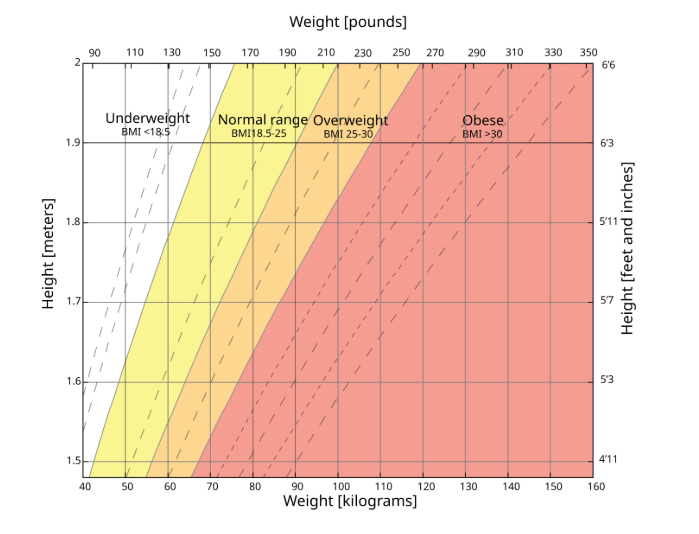
BMI Graph for Adults (above age 20)
A graph based on WHO data is shown here. Tracing your position based on your weight and height you can
know in which category you fall into.
If you fall left side of normal range then you are in the too thin category and if on the right you are
in too too-fat category. How much too thin or too fat you are can be guessed looking at the dashed
lines.
1. Underweight: BMI less than 18.5
The individuals falling in this category may have insufficient body fat, which can be the cause of a
health issue. Probable causes for being underweight may include medical conditions, excessive physical
activity, or malnutrition.
2. Normal Weight: BMI between 18.5 and 25.0
A BMI score in this range is considered healthy for adults and is associated with least risk involved in
developing body weight related complications.
3. Overweight: BMI 25.0 – 30.0
Being in the overweight category puts you at increased risk of developing physical conditions such as
heart disease, hypertension, and type-2 diabetes. Lifestyle improvements like increased physical
activity along with a balanced diet are often recommended to individuals in this category.
4. Obesity: BMI between 30.0 - 40.0
Obesity is a serious health condition that is associated with the risk of developing chronic diseases
like certain types of cancer, cardiovascular diseases, and high blood pressure. Weight loss efforts are
typically advised through increased physical activity and diet control under medical supervision.
5. Severe Obesity (Morbid obesity): BMI >40
This category indicates a severe level of obesity in the individual, which is associated with a large
number of potential health risks. In many of such cases a professional medical treatment and also
possibly surgical options can be required.
BMI for Children (aged 2-20)
For children BMI is not just a number but it is a percentile ranking that compares their BMI to the BMI
of other children of same age group and same sex. These percentiles get calculated based on the data of
growth chart developed by organizations like World Health Organization (WHO) and Centers for Disease
Control and Prevention (CDS).
BMI Categories and Their Implications for Children (age 2-20)
|
Category |
Percentiles |
| Underweight |
Less than 5th percentile |
| Healthy Weight |
5th to 85th
percentile |
| Overweight |
85th to 95th
percentile |
| Obese |
Above 95th percentile |
Once a child’s BMI has been calculated, it is categorized into these groups based on their percentile.
1. Underweight: BMI below the 5th percentile5
Children falling below the 5th percentile are considered underweight. This condition may indicate that
the child is not getting enough nutrition and the normal growth process is getting disrupted. In such a
situation it is advised to get medical attention and the underlying potential causes are addressed.
2. Healthy Weight: BMI score between the 5th and 85th percentile
Children in this category are considered to have a normal weight according to their height and age. The
majority of the children fall into this category. Children in this category are normally at the lowest
of potential weight-related health issues.
3. Overweight: BMI score between 85th and 95th percentile
Children falling in this category are considered overweight which means that these children weigh more
than 85% of children in their age and gender type, but they are not obese yet. The children in this
category have a high probability of developing health-related conditions like type-2 diabetes, heart
complications, and high blood pressure later in life.
4. Obese: BMI above 95th percentile
Children in this group definitely are at a significantly greater risk of facing obesity-related health
conditions. Childhood obesity can result in a number of health complications such as sleep apnea,
cardiovascular complications, mental health issues, and joint problems. This condition requires
professional medical intervention which can oversee a balanced diet regimen for the child and also
indulge in physical activities and reduction in screen time.
Why Use a BMI Calculator?
A BMI calculator is an invaluable tool to identify potential health issues in an easy way. A few reasons
which make it so useful are listed below.
1. It works as a screening tool
A BMI calculator is an easy tool to screen an individual’s potential health complications that can arise
from weight-related issues.
2. Preventive Health Regimen
Once you have found yourself in the overweight or obese category, you can make lifestyle changes in your
daily routine and avoid potential chronic diseases of the future.
3. Tracking your weight gain or loss
Regularly checking your BMI in an easy way to know the effect your diet and physical activities are
having on your body. If you notice big ups and downs in your BMI score, it is an indication that the
changes you made in your lifestyle have started showing the effects on your body.
4. Simplifies Health Discussions
BMI can act as the starting point in your discussions with your healthcare worker. It can form the basis
for further treatment required by the individual.
Limitations of BMI
While BMI works as an easy screening tool, it does have a few limitations. Here are listed a few of
them.
1. BMI does not differentiate between muscle mass and fat mass.
Sports persons, especially athletes, may have high muscle mass in their body and do not have higher fat
mass, but can result in higher BMI. So, a person who has a higher BMI not necessarily be overweight or
obese.
2. Does not account for fat distribution in the body.
BMI does not say anything about where the body fat is located. Research has proved that the fat stored
around abdominal organs (visceral fat) is more dangerous compared to the body fat stored below the skin
(subcutaneous fat). Two individuals who have exactly the same BMI can face very different kinds of
health issues based on how the body fat is distributed in them.
3. Does Not work Well for Children
Since children are in a growing stage growth can occur rapidly at some age for a child and at a
different pace for another child, especially during puberty. Such growth spurs can result in higher
weight and height compared to other children of his age group, resulting in a higher BMI percentile, but
the child can still be of normal weight. So, this may lead to an inaccurate assessment of a child’s
weight status.
4. Not Very Perfect for Elder Individuals
In older adults, the BMI may underestimate muscle loss due to old age and give a wrong impression about
the amount of body fat accumulated in the body. In addition to BMI measurement, waistline measurement
can be of help to them in assessing their health status more accurately. A “Waist Calculator” (hyperlink
it) developed for this purpose is a handy tool that gives good results.
5. Pregnant Women
In pregnant women, the body weight can fluctuate very rapidly which results in BMI being less accurate
in diagnosing the health situation.
6. Genetic and Ethnic Differences
BMI thresholds need to be adjusted for different populations. For example, people from East Asia and
South Asia may be at greater risk when compared to people from Europe for the same BMI readings.
🔍 Frequently Asked Questions (FAQs)
How often should I check my BMI?
Checking your BMI periodically, such as once in every 6-12 months can help you keep track of
your weight gain or loss over time. But always keep it in mind not to solely depend on BMI
to know your health situation. Alternatively, if you are planning to lose or gain weight
then keeping track of BMI would always be recommended.
Can BMI help determine the eating disorders in children?
BMI is often not sufficient to diagnose the cause of eating disorders like bulimia or
anorexia in children. A very high or very low BMI in children can indicate an eating
disorder, still, it is not sufficient to conclude of any specific abnormality. Dietary
evaluations and medical monitoring are also required apart from BMI measurement.
Is it okay to use BMI calculators from different online websites?
Different BMI calculators may have slightly different methods for calculating BMI, depending
on the tools they use. Most calculators will give consistent results, still, it is advised
to use a trusted BMI calculator from a trusted website.
Does BMI take into consideration the metabolic health?
No, BMI does not take into account metabolic health. Someone with a normal BMI can have an
unhealthy metabolism with high levels of fatty deposits and insulin resistance.